Lee and I are scheduled to go to WAIS tomorrow morning, we have a few stations to visit in West Antarctica and we will (hopefully) get a chance to fly on twin otters from WAIS camp. I can’t believe I am going to WAIS before I visited any stations on the Ross ice shelf. I really-really hope we will get to return on-time to do a few of the long list of scheduled stations to visit this season.
The weather in McMurdo has not been that great yesterday and today, so it is at least not that surprising. Tall Tower! weather also has not been ideal – low clouds make it difficult to visit Tall Tower! during this season.
If we do get to fly tomorrow, Lee and I will be away from the internet for a while. We did get our WAIS emails: first six letters of the last name + first two letters of the first name @wais.usap.gov
I hope I will not get to update for some time 😉
Masha
Lee and I are scheduled to be canceled for Alexander Tall Tower! tomorrow (again!) and on Wednesday we are scheduled to be canceled to go to WAIS 😉 I think I am almost getting used to it.
I listened to Lee’s advice and scheduled my snowmobile training today despite us being scheduled as a primary and as a backup flight for today. We woke up to a light snow and poor visibility in McMurdo, it also turned out that Tall Tower! weather wasn’t acceptable for landing either, so we got canceled right away at 7am – did not even have a weather delay. This allowed me to do the training. It was a lot of fun, although somehow I imagined driving a snowmobile to be very different (I have not driven one before). The visibility was not the greatest, so I don’t have a spectacular picture like Dave had earlier this season. But I am now officially done with all the possible trainings – all the cancelation days were put to good use 😉 I am ready to drive a truck, a snowmobile and to go to a field camp.
Lee, Joey and I also went to McWeather and had a nice chat with forecasters. It was really cool to talk to them and to see the AMRC sign there. A special “hello from Matt”.
Unfortunately it looks like temperatures at Pegasus will stay somewhat warm for a couple of days, which will not help the road or the runway. We did ask the McWeather people about their ability to change the weather, but somehow they did not admit to it 😉
I wish I had more exciting news to post. Oh, I know, I know! I did get to see the penguins yesterday (Sunday, January 6). Two Adelie penguins came to Hut point, they were swimming in the water, then climbed on an ice floe, walked around, performed their washing before bed routine, slept, woke up an eventually went back into the water.
As I mentioned before my “happy camper” instructor moonlights as a photographer, he managed to get some amazing shots, so here’s one:
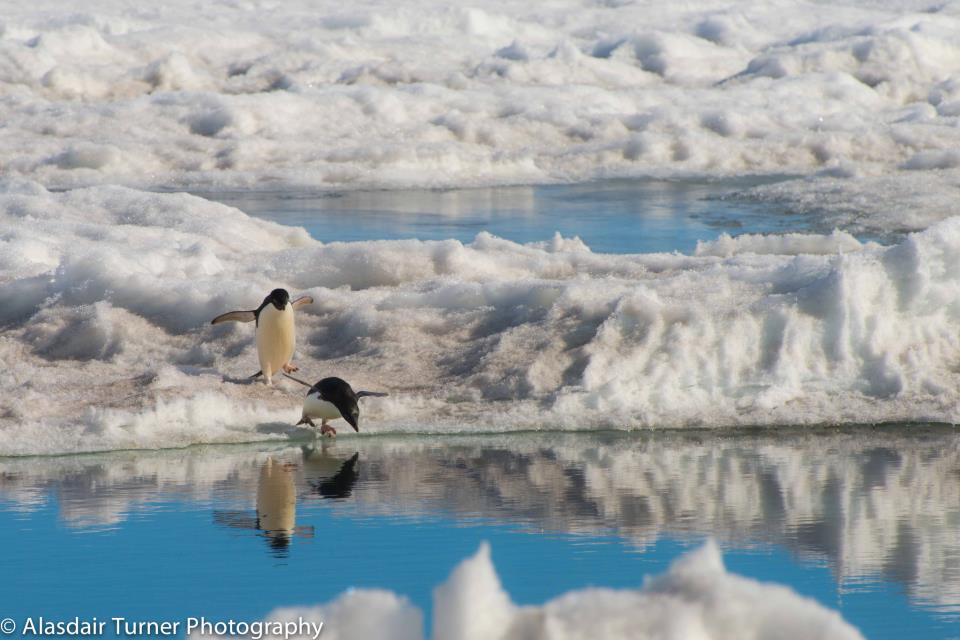
(after posting Alasdair’s pictures here I feel a little inadequate posting my crappy point-and-shoot-not-sure-what-I’m-shooting pictures. So let me apologize in advance for those).
Unfortunately I do not have a lot of new things to report on.
The road to Pegasus (the runway) is really bad right now, so it takes at least two hours to get there. This already eats up four hours in pilot’s workday, making any weather delays an almost certain cancelation. On top of that shuttles are not running as frequently to avoid the overuse of the road. All these factors led to Lee and I getting canceled on a flight to Alexander Tall Tower!. Again.
This is really unfortunate, cause weather here in McMurdo is beautiful – it is sunny and warm (also not helping with getting the road to Pegasus into a better shape). I was really looking forward to flying somewhere and shooting amazing photos 😉
I do have a great picture from my “happy camper” experience to share – my “happy camper” instructor Alasdair moonlights as a photographer. So here’s one of Alasdair’s pictures of me with a white bucket on my head. I am trying to find flags to get to the bathroom:
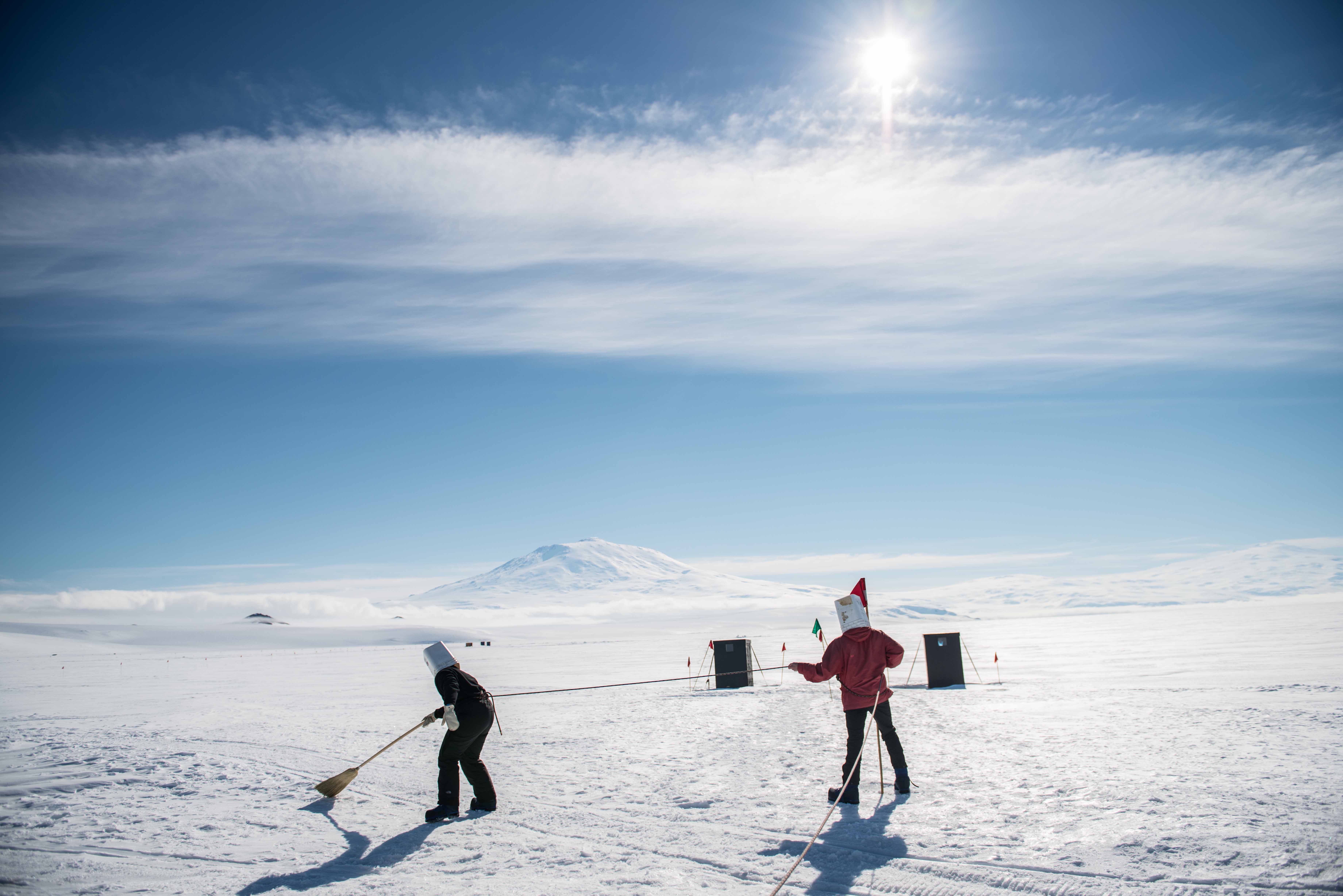
For those unfamiliar with this exercise – the white buckets on your head simulate the whiteout conditions. It is amazing how easy it is to loose the sense of direction/orientation when you visibility is limited. You can’t really hear anything either and talking to other people is really difficult.
We were simulating a situation where we lost a member of our team. Last we heard he went to the bathroom and we were launching a rescue operation from the iHut to the outhouses. All paths in all field camps are marked with flags – these makes them easier to find in limited visibility conditions. We did not, however, had ropes from flag to flag – something that would have been really useful in a complete whiteout. I managed to find the first flag (thanks to the broom!), but went way of course in search for the second one. My partner Andy actually tried to steer me back – he could feel that I went in the wrong direction, but it was hard to understand his signals via rope and I couldn’t hear him at all. I eventually corrected myself (with a lot of help from Andy), but we ran out of time and got pulled back in by other team members, who were worried that we will get hypothermia (whiteout conditions are associated with high winds and low wind chill temperatures).
You can also see what a gorgeous sunny day it is – no wonder the runway and the road to it are melting. The iHut is located just a few hundred meters off the road to Pegasus – on Ross ice shelf.
Also, I wanted to advertise my personal blog about my non-work adventures in Antarctica. Anyone who is interested is welcome to follow it:
http://aws2013.blogspot.com/
I hope I will soon have more exciting news to report about all the stations Lee and I manage to get to 😉
Thanks for reading,
Masha
Hello, everyone!
My name is Masha Tsukernik and I am a new member of the team. Dave has left the ice before Christmas and I was supposed to get in on the 27th December. It has been unseasonably warm, so the runway melted a little earlier in the season then anticipated. A lot of flights got delayed, canceled, or postponed because of that.
Lee did manage to get some Helo time when he was here as a solo member of the AWS team and he visited a couple of sites. One in particular was giving him hard time, but we are happy to report Lorne is up and running now!
Since I got in so late I was only able to do the “happy camper” school on January 2-3. I am now officially happy and allowed to go to the field. Lee and I are now waiting for Twin Otters to get down to McMurdo. So far the last couple of days were really warm – no plane was able to take off from Pegasus. There is some hope to tomorrow – an LC-130 came down from Christchurch tonight and hopefully more planes will come and leave tomorrow as well.
Hoping to update soon,
Masha
Since it has been a whole week since my last post, I wish I could say it has been an incredibly eventful one full of station visits. Unfortunately, that hasn’t been the case, as the only station we visited was Windless Bight, which we went to yesterday (18 December). In this post I’ll go over 1) our numerous flight delays, 2) our visit to Windless Bight, 3) some extra photos that I’ve taken, and 4) closing statements (as this is, in all likelihood, my last post for this field season).
1) We have had many flight delays when trying to go to Alexander Tall Tower!, White Island, and Minna Bluff. Tall Tower is one that Lee has been anxious to do because he has tried to make it out there for the past couple years but hasn’t been able to. We had already gotten weather-delayed a couple times earlier this season when trying to go to there. We were scheduled to fly out on a Twin Otter this past Friday, 14 Dec, but one of the Twin Otters needed to go to South Pole, so our next possible option was to go there today actually. We will not be going there today because we had other plans, as I will explain later, and it is snowing so there would be no flying anyways.
The wind direction at Minna Bluff AWS needs some repairs, so we were planning on taking a helo (helicopter) to visit that station, and return to White Island AWS to finished up our installation, in one trip. Our original plan was to do this trip on Saturday, 15 Dec, but they didn’t have enough helos available due to maintenance issues. We got bumped back to Monday. Come Monday, we got everything all set and ready to go, and were waiting at the helo pad to depart. After waiting for two hours (they were still backed up with flights due to maintenance issues), our flight got postponed due to low clouds on White Island. To give you an idea of what it looked like that day, here is a picture of White Island from Scott Base (granted, this picture is about 5 hours after we got cancelled):
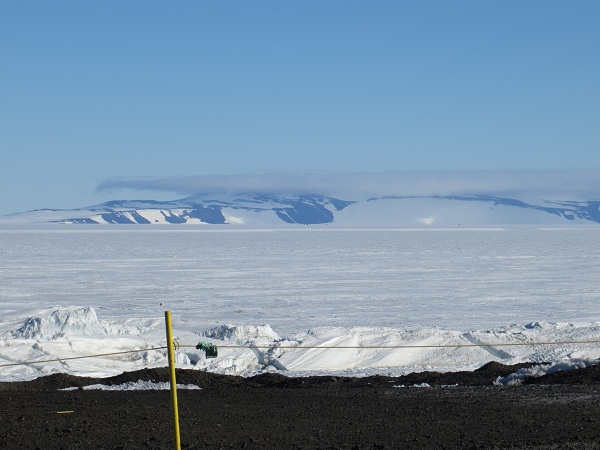 17 December: White Island and the low cloud cover You can see how it can get frustrating when delays occur; the weather was great at McMurdo, and it was as if the only clouds were at White Island (and probably Minna Bluff, too). Our flight then got bumped back to yesterday, 18 Dec, but Lee and I were already planning on snowmobiling out to Windless Bight. If our helo flight would have been scheduled for the morning, we may have been able to do both trips in one day. Alas, it was scheduled in the afternoon, so we needed to reschedule the helo flight to today. Today, it is snowing. So our flight got postponed, again. I’m learning (maybe the only way one can), and have now been reminded of many times, that it is very difficult to conduct our type of work down here in Antarctica. From the weather to the maintenance to everyone else’s schedules, it can be very difficult to actually get out to stations.
2) I’ll start off the discussion about our trip to Windless Bight AWS by saying that it turned out to be a successful trip! We needed to swap out all of the instrumentation and set up the new power system there. It will be transmitting its data through White Island AWS. It was very satisfying to get the work done.
We left in the morning around 9:30 am to get to the snowmobiles and didn’t start our trek out to Windless Bight, which is northeast of McMurdo near Mt Erebus and Mt Terror. It took about an hour to get to where we thought the station was, but we couldn’t locate it in the area, and due to low fuel levels in our snowmobiles, so we had to head back to McMurdo to refuel.
We ended up departing for Windless Bight at 2:30 pm and arriving at the station at 3:30 pm. Here is a picture of the station when we arrived.
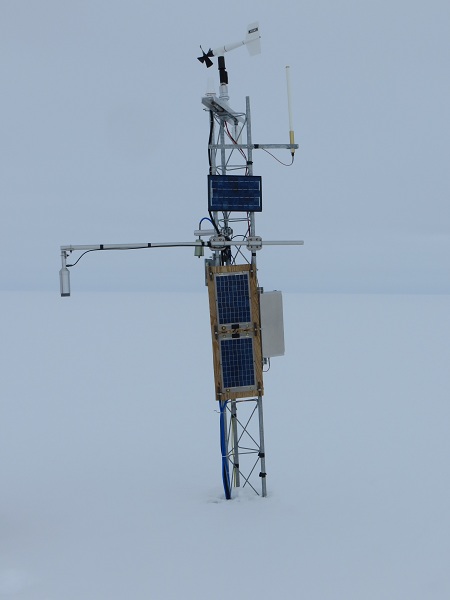 Windless Bight AWS when we arrived Notice the cloud cover; we were scheduled on helo to go to White Island and Minna Bluff, but with that cloud cover there was no way we were going to make it out anyways.
The work at the station went very smoothly. Here are a couple pictures of Lee and I working on the station.
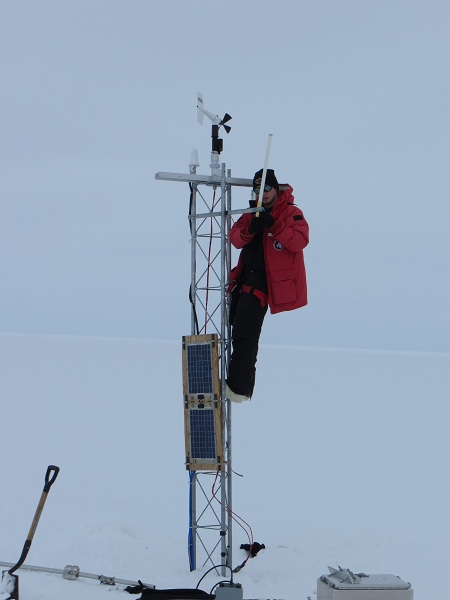 Me removing the antenna 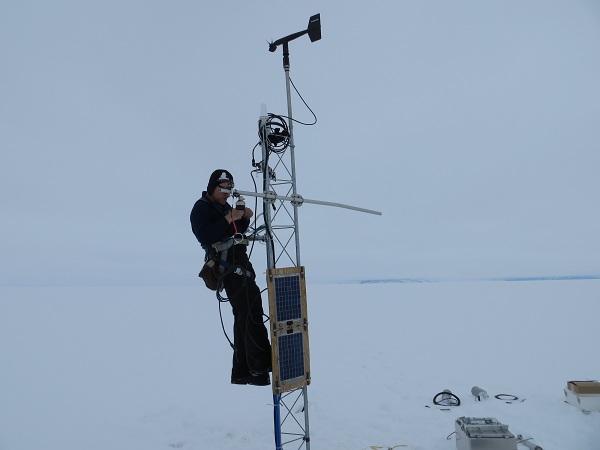 Lee installing the boom At 9:30 pm we finished our work. Here’s the picture to prove it:
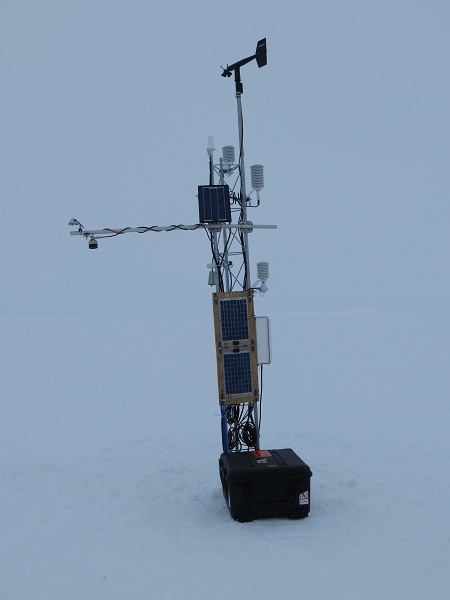 The updated Windless Bight AWS We departed for McMurdo at 9:40 pm and arrived at Scott Base (where we retrieved our snowmobiles and needed to store them) at 10:30 pm. On our way back, the sun came out for a bit. What a huge difference the sun makes in terms of being able to see the topography of the snow surface! It made driving the snowmobile much easier. Here’s a picture from that time, with the supplies Lee towed hooked up to his snowmobile.
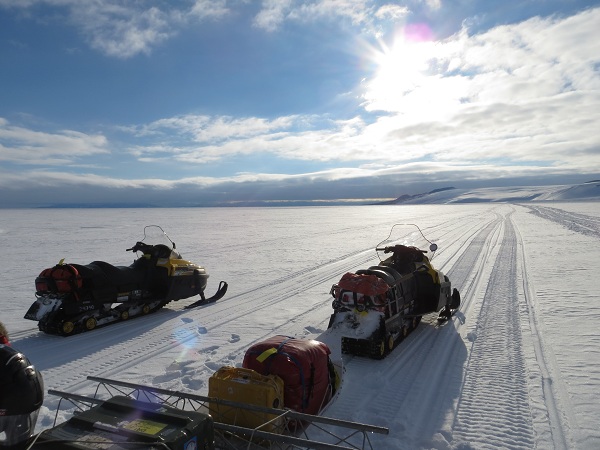 Picture taken around 10 pm. Observation Hill is the black bump just about directly below the Sun on the horizon. After refueling the snowmobiles and everything, Lee and I were just starting to walk back when, luckily, there were a few guys with a truck passsing us by on their way to McMurdo. They offered us a ride back, which was a huge relief for us. Otherwise, it probably would have been a 40-minute, exhausting walk. Both of us were very tired after that long day of work.
When we returned to McMurdo, we went to the Galley to get our dinner that we asked to have held for us. We got there around 11:30 pm, and they had thrown out our dinner because (as we originally said) we were supposed to get it at 10 pm. The guy we talked to was very nice and said we could have the Mid Rats (midnight rations) dinner instead (you’re supposed to have a card indicating you can have it, which we didn’t). We were both kinda glad it worked out that way; fresh food, and our choice. And it was delicious. One advantage of working such a long day is the meal afterward is that much more rewarding.
3) Here are a few extra pictures that I’ve taken.
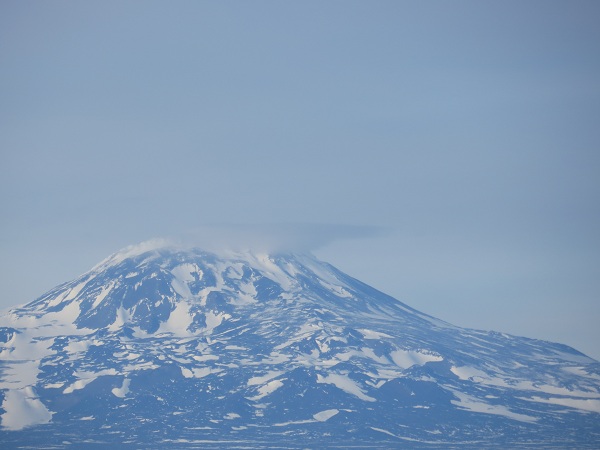 A lenticular cloud at Mt Discovery 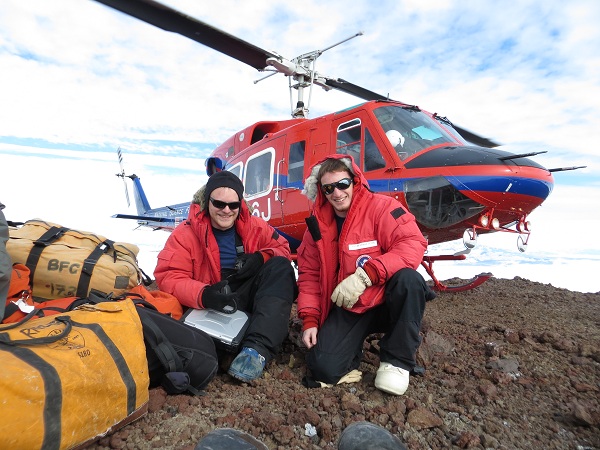 Lee and I and the helo on White Island 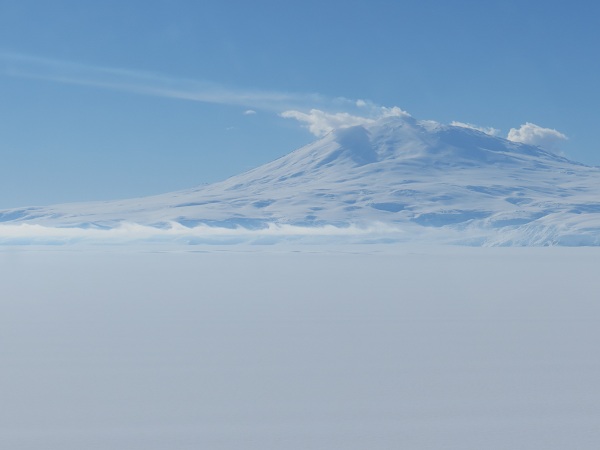 On the helo flight from Ferrell to McMurdo, showing Mt Erebus’ “contrail” and Kelvin-Helmholtz instability in the low-level clouds 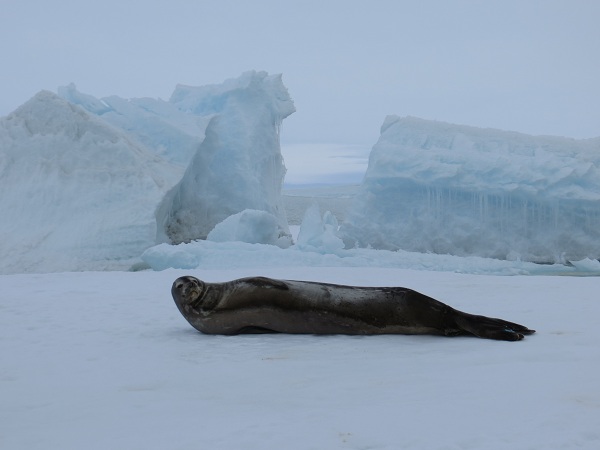 A seal, posing for the camera, on the Pressure Ridges tour. The pressure ridges are basically “ice-waves breaking” as the sea ice collides with the land. They are found near Scott Base.  Can you find the moon? 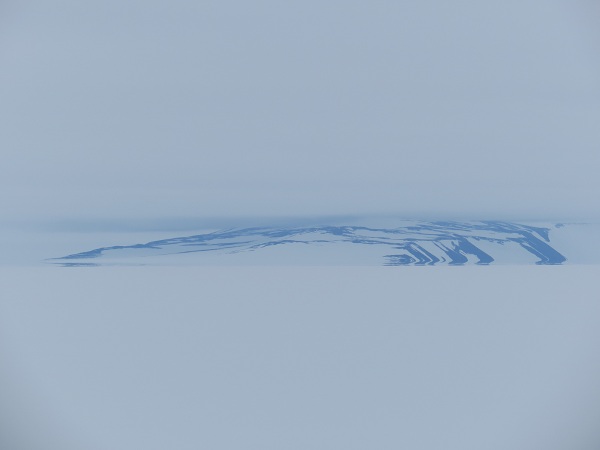 Looking at White Island on our way to Windless Bight, with a fata morgana (mirage) seen on the horizon 4) I just got my flight schedule a few minutes ago, and I am scheduled to depart tomorrow morning. With that, I think this will be my last post. It has been a very fun experience down here, though sometimes it was a little frustrating. I’m glad we were able to get some work done, albeit much less than I anticipated. So it goes, with life down here in Antarctica.
So there you have it. Days in the life of Dave.
Cheers!
Yesterday (on Wednesday, 12/12/12) Lee and I made the helo trip to Ferrell to remove instrumentation from Ferrell. The trip was successful, but there were a couple delays along the way. In this post I’ll talk 1) briefly of the weather and 2) about our visit to Ferrell AWS.
1) The weather has been mostly cloudy (some sunny spells here and there) with temperatures hovering around 30F for the past couple days, and it is like that this morning as I write this. Lee and I had originally planned to visit Ferrell on Tuesday, but low clouds and fog resulted in our visit being pushed back to Wednesday; the visibility was too poor for the helicopter, as the surface definition was not high enough (it’s very difficult to land if the pilot doesn’t know where the surface of the snow is).
At Ferrell AWS yesterday, the weather in general was great. Calm winds, fairly warm, and mostly sunny to partly cloudy skies. Back in McMurdo, the low clouds (I think) dominated the weather for most of yesterday.
The winds have generally been light and variable around McMurdo, and only a few occasional flurries have made their way to the surface in the past few days.
2) At around 11:15 am yesterday, we departed McMurdo on the helo for Ferrell AWS (right on schedule). Everything was going smoothly, and after about 20 minutes we arrived at the coordinates which we thought denoted the location of Ferrell. The AWS, however, was nowhere to be seen. We landed there to get our bearings and radio back to Mac Ops for assistance. We had them look up the coordinates of Ferrell online for us. After another 20 minutes or so, we found Ferrell. Our initial landing was about 4 miles off. (We will need to get updated coordinates to helo ops.)
After that delay, Lee and I got all our stuff off the helo and got to work. Here is are a couple pictures of Ferrell and Ferrell II before any of our work.
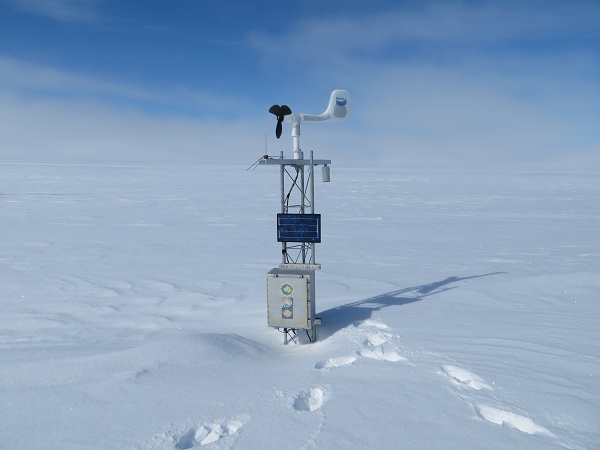 Ferrell AWS, upon arrival  Ferrell II AWS, upon arrival As mentioned earlier, the purpose of our visit here was to remove the instrumentation on Ferrell. Here are a couple pictures proving that we did that 🙂
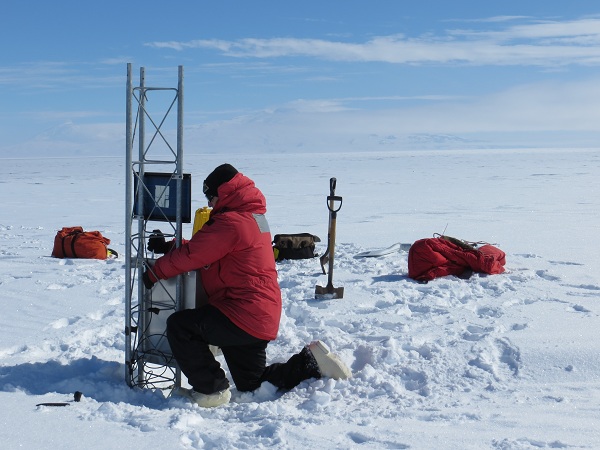 Me removing the enclosure 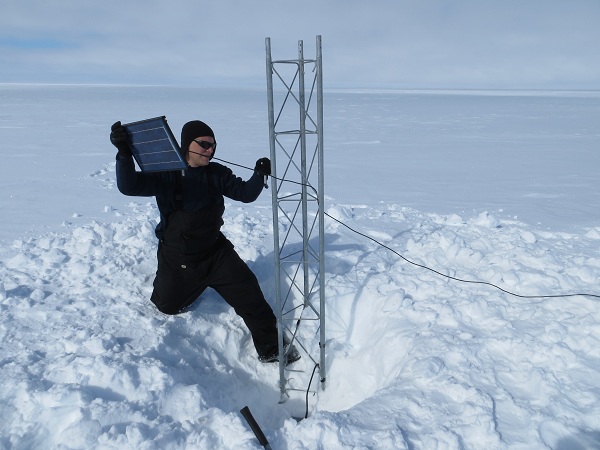 Lee ridding Ferrell of its solar panel As you may have guessed, Ferrell looked pretty plain after we removed everything:
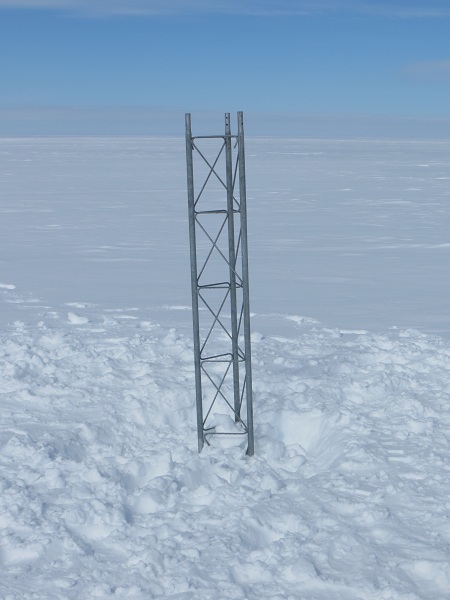 Ferrell, after we removed all instrumentation We had given ourselves three hours’ time to do this work, and we completed it in just one. We radioed in to helo ops to request an early pickup. They said they could, which was great! Lee and I relaxed and enjoyed the pleasant weather while we waited.
Unfortunately, when the helo arrived at around 3 pm, the pilots said there was some mechanical repairs needed on the transmission. We had to wait for a helo with the mechanic to come, and that wasn’t going to be for another two hours. So what was going to be an early return turned into a late one. The two pilots, Lee, and I waited in the injured helo, napping, snacking, and reading, until the mechanic came.
Luckily, the repair only took about 20 minutes and we were able to take the now-repaired helo back to McMurdo. We returned at around 7 pm, just in time to catch dinner.
Despite the delays, the trip was a successful one, and we can scratch Ferrell off the list of stations we need to visit this season.
Yesterday Lee and I, along with 3 riggers, went to White Island to install a weather station. It was everyone’s first time visiting White Island, so that in itself was very cool. It also offered some great views, there was a cool atmospheric phenomenon witnessed, and it was great for me to help install my first weather station. In this post I’ll go over 1) the installation and 2) some cool photos of scenery and that mysterious “atmospheric phenomenon.”
1) The purpose of building an AWS on White Island is two-fold for us. One, we get an AWS that will gather more data about the atmosphere for us. Two, it will serve as a repeater, relaying transmissions from Windless Bight AWS, Lorne AWS, and Linda AWS to T-site at McMurdo. This means it will need to be able to see each of those AWS. For this reason, we needed to install it on one of the highest points on White Island; we chose Mt Heine.
We got off to a later start than expected. The helicopter that was assigned to us was running a bit late. It takes about 12 minutes to fly on helo from McMurdo to White Island, so around 1:20 pm we landed on White Island. This trip definitely showcased the versatility of a helicopter. When we were a couple minutes away from White Island, the pilots asked Lee and I where we were thinking of landing. All we knew was that we wanted to install the station on Mt Heine, but no one had any idea if there was a flat place to land. Turns out, there were a few good places to land, and we reached White Island safely. If we didn’t have helicopters, I don’t think this “mission” would have been possible.
We actually needed two helo rides out there because we had so much cargo, due to us installing a completely new station and the riggers needing to accompanying us with all their gear to mount the station into the rock. The spot we chose was, we believe, the summit of Mt Heine. When we had everything there, the riggers began setting up the guy wires. Things went fairly smoothly after that, and the summit of Mt Heine went from this:
 Summit of Mt Heine, pre-AWS to this:
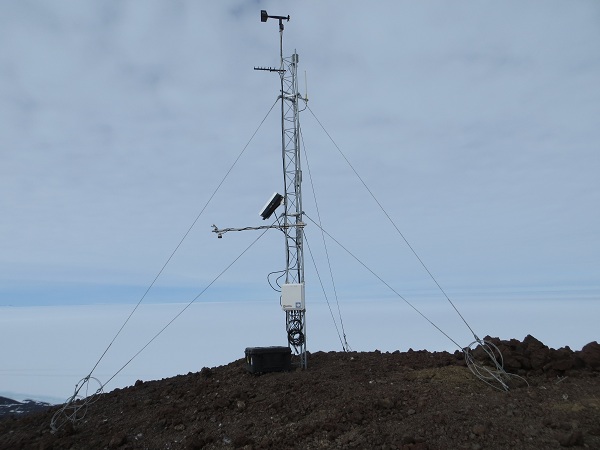 Summit of Mt Heine, with the AWS This whole installation would have been incredibly difficult and time-consuming without the help of the riggers, so a lot of credit must be given to them.
Unfortunately, Lee and I forgot to bring the power cable, so we were unable to complete the installation. As it turns out, we would not have had enough time to power up the station and test whether it was transmitting. We had already asked for a half hour extension for our pick-up time from the helo, and we probably had only 2 to 4 minutes of downtime before the helo came and picked us up in the end. We should be able to swing by White Island when we visit another AWS, so everything should work out, and we should get it up and running soon.
2) Being on White Island provided some cool views, so here are a few pictures I took…
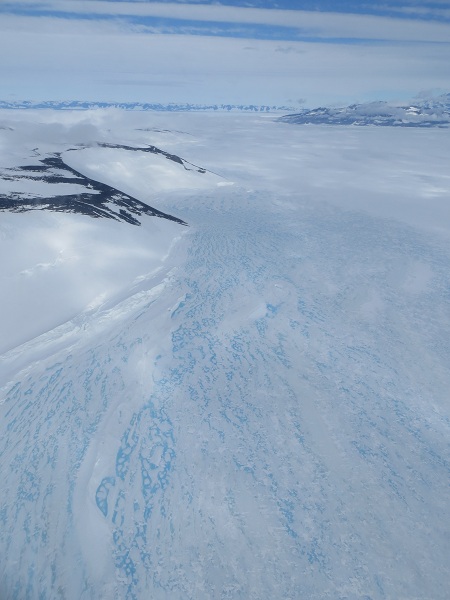 West coast of White Island, taken from the helo on the inbound flight 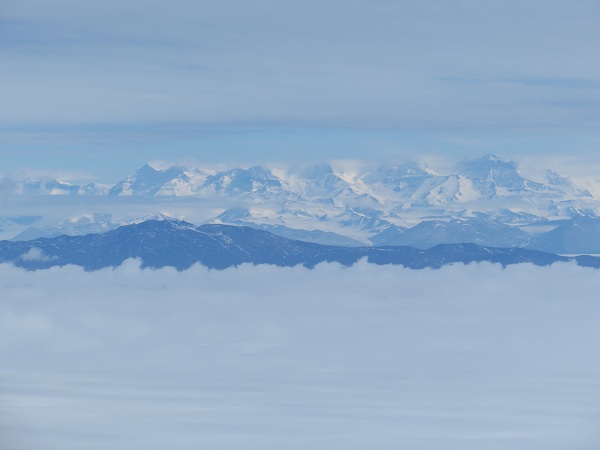 Low clouds almost imitating the Royal Society Range skyline 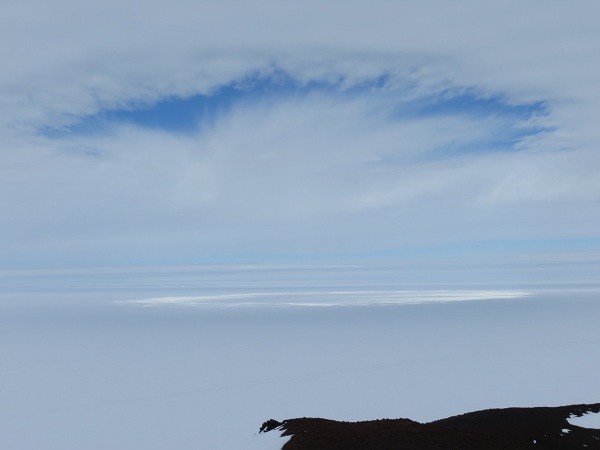 Very, very cool-looking atmospheric phenomenon, the cause of which was unknown to us…
I experienced my first Condition 2 weather down here yesterday, 5 December. Technically, I wasn’t in Condition 2 weather, but I saw it. For those of you who don’t know what “Condition 2” is: we have different conditions to indicate how severe the weather is; it determines whether or not it is safe to conduct work and travel outside. Here is an overview*:
Condition 3:
Winds less than 48 knots (55 mph), and/or
Visibility greater than or equal to 1/4 mile, and/or
Wind chill temperature warmer than -75F.
Condition 2 (all must be sustained for at least one minute):
Winds 48 to 55 knots (55 to 63 mph), and/or
Visibility less than 1/4 mile, but greater than or equal to 100 feet, and/or
Wind chill between -75F and -100F
Condition 1 (all must be sustained for at least one minute):
Winds greater than 55 knots (63 mph), and/or
Visibility less than 100 feet, and/or
Wind chill colder than -100F
*For more details, see https://www.usap.gov/USAPgov/travelAndDeployment/documents/FieldManual-Chapt10Weather.pdf
Yesterday, the most likely cause of the Condition 2 weather was the blowing snow, decreasing the visibility. Because of this, the only locations that had Condition 2 weather were Pegasus Field and the road to Pegasus Field, both of which are on the ice field off of McMurdo. Here is a “during and after” comparison of what the ice field looked like during Condition 2 weather, and afterwards when it was condition 3:
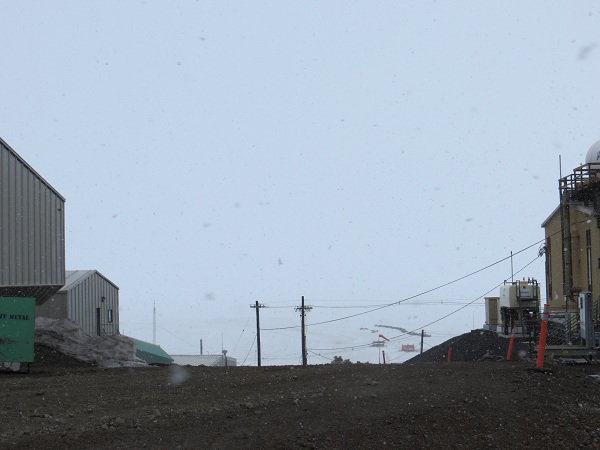 View from McMurdo, looking towards Condition 2 weather on the ice at around 12:30 pm on 5 December 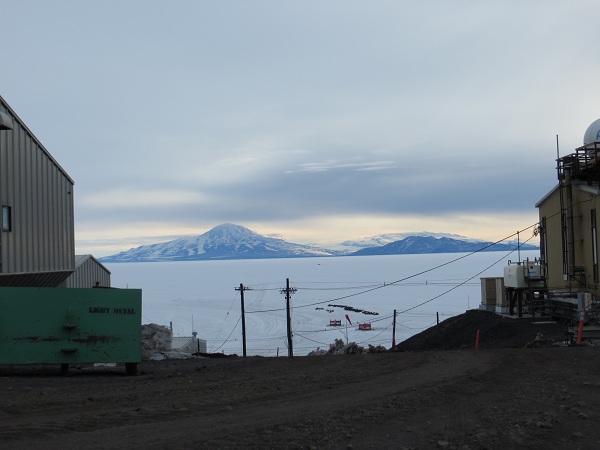 View from McMurdo, now with Condition 3 weather on the ice, at around 9:30 pm on 5 December It is incredible how much the visibility can decrease by blowing snow. There was also snow falling in McMurdo, and presumably on the ice, which surely contributed to the lack of visibility on the ice.
As cool as it was to see Condition 2 weather, it is important to realize how unsafe it is. My roommate, Adam, works for the WISSARD (Whillans Ice Stream Subglacial Access Research Drilling) Project, which is concerned with drilling in the ice. They work out on the ice there near Pegasus Field (for now), and when they were driving back to McMurdo, the visibility was so poor that the driver lost sight of the road. They ended up getting stuck in the snow, leaving them no choice but to dig and push the vehicle out. Even on something so seemingly safe as a day-trip drive to the ice can become a hazard when Condition 2, or worse, weather sets in.
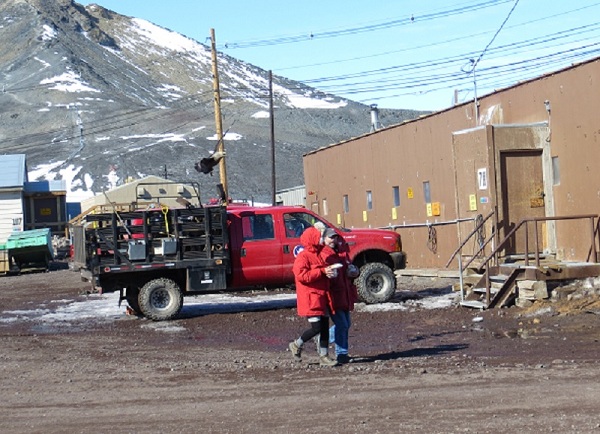
In my last blog entry, at the end, I threw in a picture of a skua attack. I realize now that some people may not have known what I was talking about, so please allow me to explain.
Skua are seabirds (similar to seagulls) that live in Antarctica. Here’s a picture of one that I took (it’s probably the same one that attacked those two people):
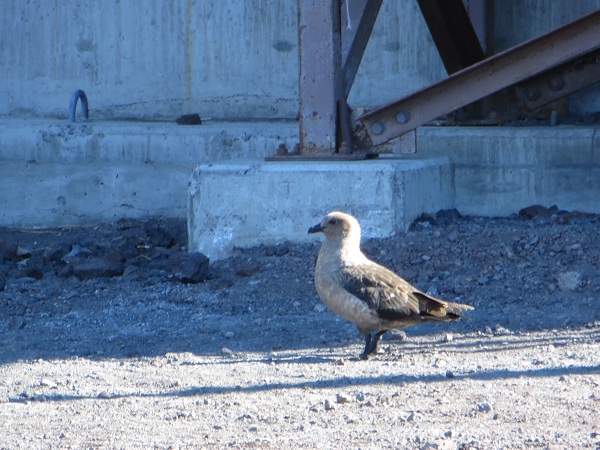 A skua They like to eat food that we humans eat. For this reason, the skua like to camp out near the Galley, where our cafeteria is, and wait for people to walk out of it carrying food. If the skua sees some food exposed, it will usually dive-bomb the person with the food in hopes of snatching a few morsels for itself. When I took that picture of the attack in action, it was around lunchtime and I was waiting for a shuttle to go to Scott Base. I had already seen one attack while waiting there, so I decided to keep my camera out in case another one happened. Sure enough, it did.
On an unrelated note, there was some cool fog this morning. Though I didn’t have my camera to capture the fog at its thickest, I was able to get a few shots of it on the hills. Enjoy:
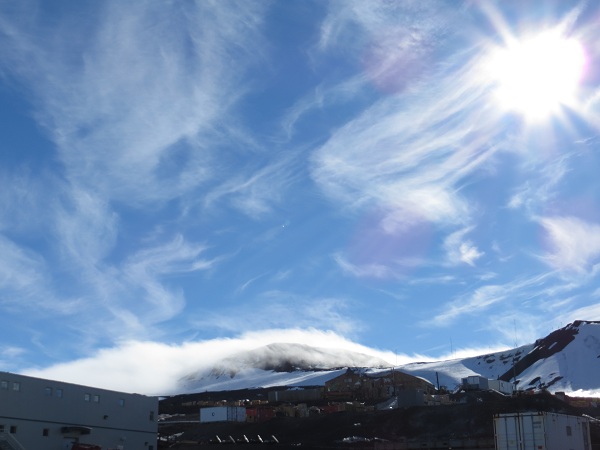 Looking North 
Hey all. It’s time for another update. I’ve survived Snow School (aka Happy Camper) and figured I’d tell the tale of it. So I will do that for point 1. As for 2, regarding the other work Lee and I have been up to, I’ll get into all the training sessions and meetings I’ve had to go to, and plans for tomorrow and the upcoming week. First, a shpeal on the weather.
The weather has been great here. Temperatures during the days have mostly held in the mid- to upper-20s. Only a couple days have been windy, while the rest have been calm. There is talk of some snow tonight, but that should be light. Hopefully the weather can cooperate for our (fingers crossed) first flight out to the field by the end of this week or early next week (if all goes well). It certainly did cooperate for Snow School…
1) From 30 November to 1 December, I went to Snow School, which is necessary for people who are going to work out in the field (our work will be going out in the field to work on our AWS). The training began with some in-class activities on the morning of 30 November, led by our instructor Suz Detweiller. We went through introductions, overviews of outdoor safety, and a case study of how things can go wrong when you’re out in the field in harsh weather conditions. Once we got that done, we all packed up our personal gear as well as the supplies we needed to bring out there, like stoves, food, etc, and headed out to our site where we would be camping. This was on the McMurdo ice shelf, north of Scott Base and the pressure field.
We took our favorite vehicle, the Delta, out there, and here’s a picture of us unloading our gear:
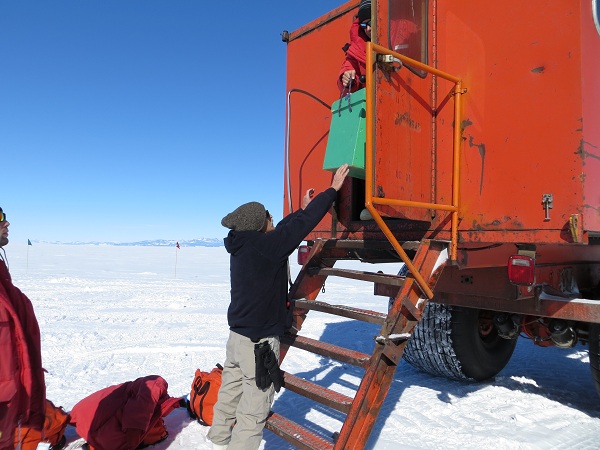 Unloading our gear (our food box in the picture) from the Delta After that, we all met in the I-Hut (Instructor’s Hut) to go over some final preparations for our stay outside for the remainder of the day until the following morning:
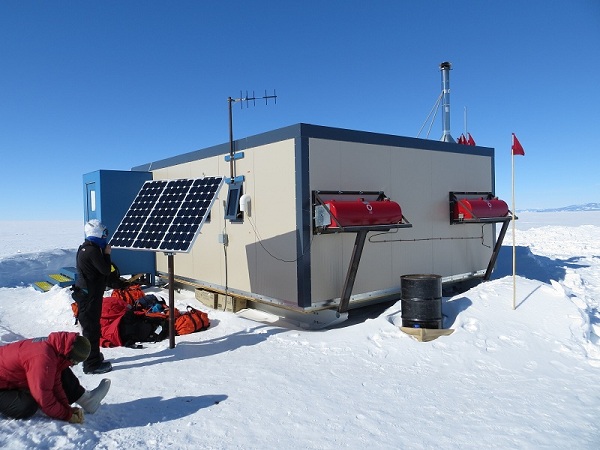 The I-Hut, with our instructor Suz dressed in black
One thing Suz especially emphasized was for us to eat plenty of food, drink plenty of water, and keep moving. This would help us stay as warm as possible. Throughout the day, we would take 5 or 10 minute food breaks to keep our metabolism high and our bodies warm.
Then, it was off to our camp site! It is called Snow Mound City, named thusly because they used to have people build “igloos” of sorts, and hence the snow mounds.
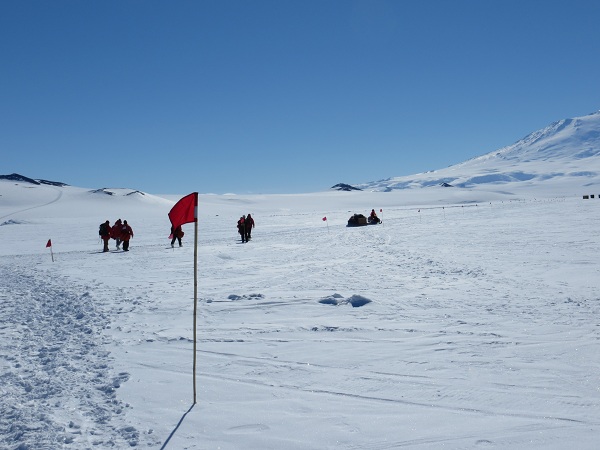 Our walk to Snow Mound City, with Suz in the front of the pack on the skidoo transporting our bulky gear Along the way, we stopped at the supply hut, where we retrieved our tents, flags, stakes, etc, and brought those to camp. The first thing we did when reaching camp was putting up one of the tents, and I think we did a fine job:
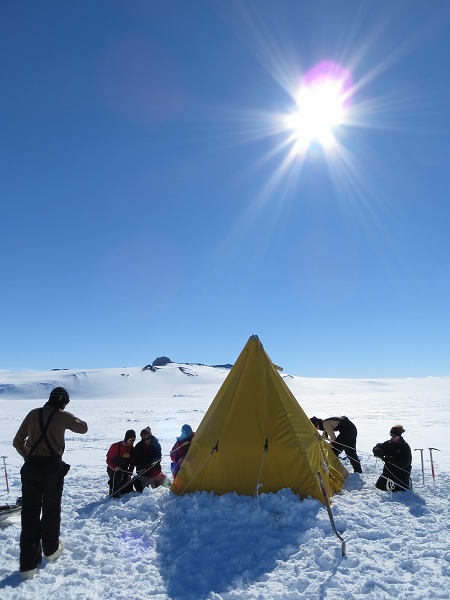 The Scott tent, our first tent we set up One very important thing we learned about setting up tents is to use deadmen. These are sticks, stakes, or any straight rod that you bury in the ground near the tent, with ropes, which are attached to the tents, wrapped around the item you buried. This keeps the tent stationary so it doesn’t blow over in the wind. They work incredibly well.
Suz then showed us how to build snow blocks for our wall to block the wind, aided us in building another tent, and provided some last minute advice. At around 5 om that night, we were on our own until morning. We all worked hard to transform what was just a simple, flat snow surface into this:
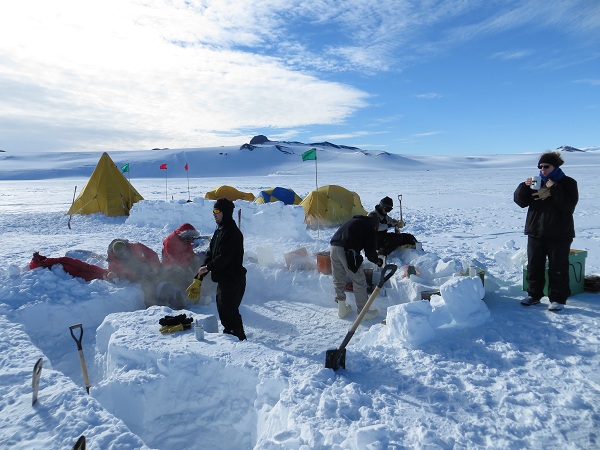 Our Snow Mound City As you can see in the picture above, we set up 4 tents total. We built a wall made out of blocks of snow that was intended to block the wind from the tents. Unfortunately, as indicated by the flags, we should have put the tents on the other side of the wall. Around 3 in the morning on 1 Dec, the wind shifted slightly from approximately northerly to northwesterly, and it picked up speed. It was amazing how rapidly it shifted. It was as if someone flipped a switch.
The “kitchen” was where we did, as you may have guessed, all of our cooking. We had three stoves running, with two large pots of hot water. This enabled us to have drinking water, coffee, tea, oatmeal, and the frozen meals for dinner. This whole experience went by fairly smoothly because we all were really good at working together as a team. No one was slacking off too much, and everyone was willing to do their part to make everything run smoothly. That really helped to make it an enjoyable experience.
Suz gave us a VHF (very high frequency) radio so we could radio in to her to check in at times we established, and to use if there was an emergency. I volunteered to use it, so that night I radioed in. There were some clouds approaching, most likely due to a warm front from a cyclone to our west (which would explain the winds), so I asked her to get a forecast from Mac Weather. Luckily, there was only cloudiness and some wind, but no snow, or whiteout conditions, or anything.
I was very curious about the weather because I planned on sleeping outside that night. I did not want to get snowed in to my trench! After hearing that forecast, I felt much more comfortable in sleeping in my trench that night. And here are the sleeping quarters I made for myself:
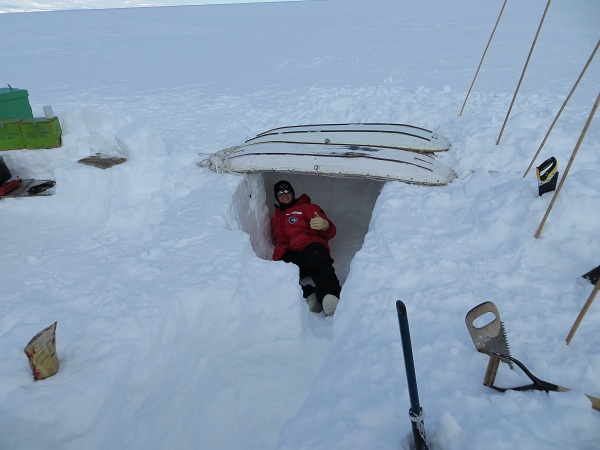 My trench, with banana sleds on top to block the wind and sun It took me a while to get all of my sleeping gear set up, but once I got settled in, the trench worked pretty well. I and another member of our group were the first to get up the next morning, around 4:30 am, and we prepped hot water for everyone. A few hours later, we all packed up everything and tore down the campsite. Our last few exercises involved using an HF (high frequency) radio, building a camp as quick as we can, and how to rescue someone in whiteout conditions. For that last one, we wore white buckets on our heads (yes I’m sure it looked hilarious) and used a rope that we all held on to so we would know where everyone is as we ventured out to rescue that person. It was almost impossible to see, very hard to talk, and very scary. It would be nearly impossible to go anywhere in whiteout conditions.
Once we were done in the field, we went back to go over some final items, and then we were done. I graduated Snow School, and I had a blast doing it.
2) Another training that I’ve done is light vehicle training. This is so I can drive trucks, primarily to move cargo from the cargo yard to Crary Lab.
I had to pause on writing this post because I had to go to snowmobile training, and this was almost as fun as Snow School. First we talked about the safety aspects of riding snowmobiles, went over the different parts of the vehicle, and finally went out in the ice to drive them. That was my first time driving a snowmobile, and it was a blast. Our instructor, Dale, was a very nice guy and was kind enough to take a picture of me on my beast of a ski-doo:
 Me on the snowmobile on the McMurdo Ice Shelf Now that I have all that knocked off the to-do list, Lee and I just need to have some meetings about helo and twin-otter flights, and hopefully we can get out to our first weather station at the end of this week!
I’ll wrap this post up there, and come by with more updates later.
Dave
….and I’ll close with a picture of a skua attack (no injuries). And yes, I was waiting for it to happen so I could capture it 🙂
|
|